
Reframe or Drown
The grief you have to fight for

A public wall of private grief. So many tears contained in script. Long form loss.
The Barbican in London recently held an event about grief, and a pop-up shop became a place to gather and share reflections and stories. As I stood and read the notes tacked to a wall, the air itself seemed to grieve — heavy with absences, crowded with the unnamed.
It wasn’t all about grief forced on another by death but also loss through relationship fractures. Some chosen, others more heartbreaking. What I noticed, though, as I traversed the wall, was that there was little about the type of grief I have been navigating. How hard I have had to fight to let myself feel it.
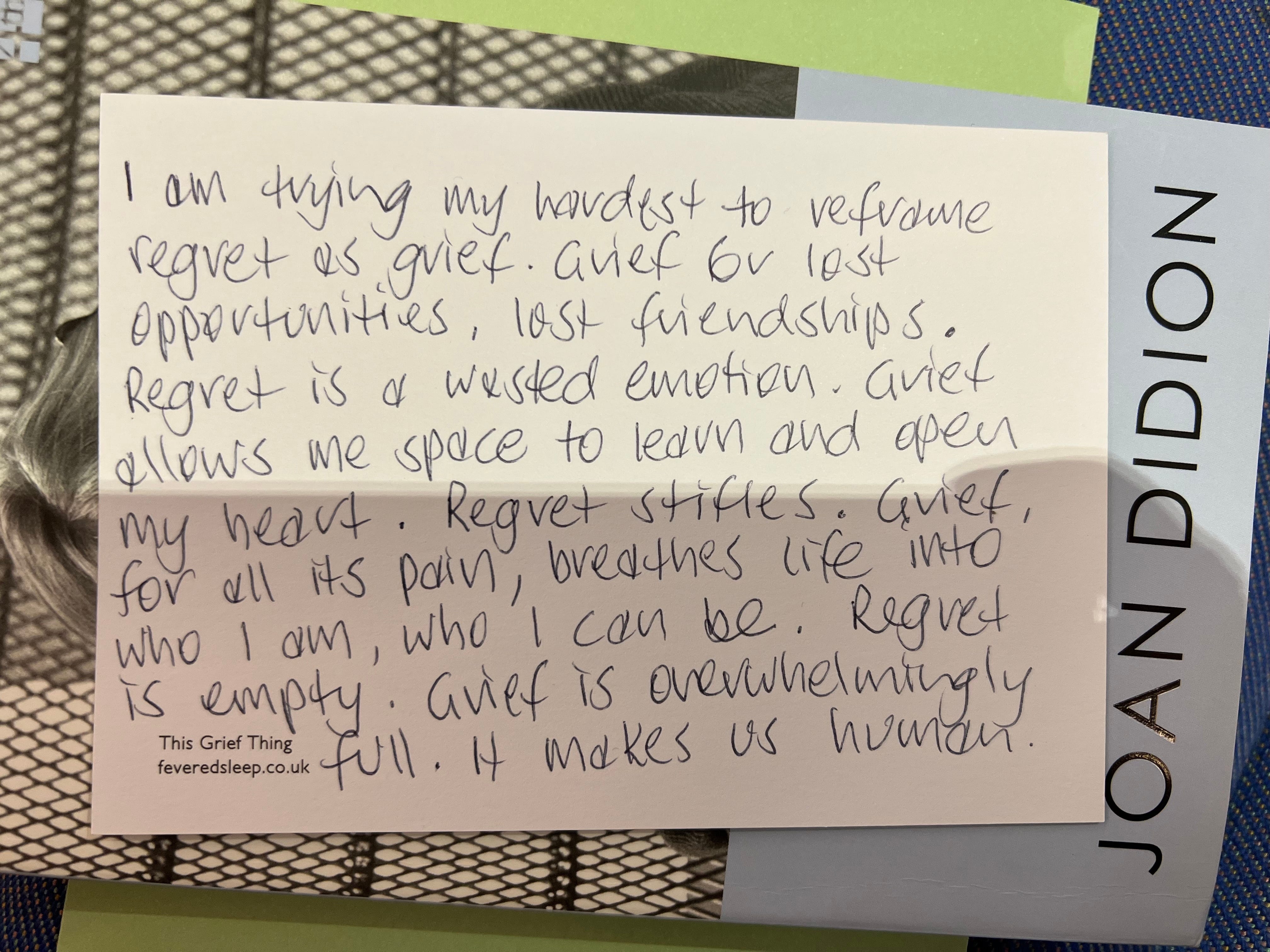
This is what I wrote:
I am trying my hardest to reframe regret as grief. Grief for lost opportunities. Lost friendships. Regret is a wasted emotion. Grief allows me space to learn and open my heart. Regret stifles. Grief, for all its pain, breathes life into who I am, who I can be. Regret is empty. Grief is overwhelmingly full. It makes us human.
Five years ago, my daughter recommended the book The Midnight Library. Everyone else in my family read it. I tried. I couldn’t even really explain what the block was, but after attempting it a few times and not being able to get through even the first few chapters, I gave up. I put it back on the shelf. I packed it in a box and brought it to the UK. And it remained on a shelf for another 3 years.
For those unfamiliar, Matt Haig’s novel centres on Nora Seed, who finds herself in a library suspended between life and death. Its shelves hold infinite books, each one a version of the life she could have lived, had she made different choices. At its heart sits the Book of Regrets, a catalogue of every decision she wishes she could undo.
In offering Nora the chance to try out different lives, Haig’s library is seductive precisely because it mirrors what regret does to us. Every unlived life that remains theoretically accessible feels like possibility. But it isn’t. It’s paralysis dressed as hope. When every path is still available, you can’t fully inhabit the one you’re on. Nora discovers that the lives she didn’t live weren’t the problem. The problem was the weight she’d assigned to not having lived them.
Last month, something made me pull the book off the shelf. I think it was as simple as selecting from what I already owned rather than succumbing to yet another bookshop temptation. I devoured it. But now I understand what had stopped me before. I simply could not have navigated it. I was not ready to face the “Book of Regrets” until I moved through my own paralysis.
Regret and grief are often treated as synonyms or at least cousins. I have taught myself the difference. I had to. It was about survival. Reframe or drown in a story that was only ever half true.
Regret is cursive; it loops. It keeps the unlived life alive as an accusation. Regret is fundamentally a counterfactual state — the mind running the same simulation on repeat, changing one variable, hoping for a different output. Psychologically, it keeps you tethered to a fixed point in the past. It’s also implicitly self-punishing: regret carries a verdict. It says: You made the wrong choice, and you should have known better.
When I was drowning in regret, I couldn’t be curious. The punishment of regret was stopping me from being open to what those experiences might teach me. It contracted the aperture of what felt possible because it was always gesturing backwards toward the unlived alternative.
The library isn’t freedom. It’s a beautiful, aching trap.

Rather than remaining stuck, I have learned to grieve for moments that didn’t go the way I might have wanted, and it has allowed me to move forward.
Rather than being a person who made a mistake, I could allow the experience to become part of me rather than a case against me.
I learnt that humans are remarkably capable of incorporating painful experiences into a coherent sense of self, but only when those experiences are processed as things that happened rather than evidence of who we are.
It seems so easy to write these words now, but the work is hard and ongoing. Years of regret had become part of how I understood myself. I am someone who made that mistake. Once something becomes identity, it’s very hard to move. And often, the willingness to do the hard work isn’t enough on its own. It may, as it did for me, require professional help. What I also learnt, though, is that the freeing of space — emotional, cognitive, imaginative — is its own, ironic kind of breakthrough. Not a dramatic rupture, but a slow clearing. Room, finally, to move toward rather than away. The unlived life stops being a haunting and eventually becomes just a path you didn’t take.
Regret keeps the wound open by picking at it. Grief lets it scar.
The experiences, the wounds – they are not nothing. They’re just healed. They will leave a mark that becomes part of you. To run your finger over from time to time, to remember how you became you and how you are worth the pain.
As I think about those notes on the Barbican wall now, I can sense the different types of pain. The ones where the words reeked of regret, of open wounds, and others where the skin-tearing had at least begun its healing. I hope all those writers find the fortitude to let the scars form, as I have learned to accept them as part of who I now am.
Pushed to the limits for my little brain, but I enjoyed reading it. Mine will never be the most articulate or insightful response, but it certainly broadens my thinking. I’ve always had ‘what-if’s’ - if choices or circumstances had been different, a million lives that could have been. I’ve required little really and have had security and calm (mostly) with my life partner.
Beautiful reflections here, Bec! The library element reminds me a tiny bit of Borges’ The Library of Babel.
Great to read your teasing out the nuances between the terms here, as well! Feels like a cathartic distinction there between grief and regret - one we can all make good use of, no doubt.
Thank you !!