
True Likeness
From the red carpet to the portrait gallery — on visibility, performance, and what we choose to let people see

Earlier this week, millions of people watched other people be looked at. Hardly anyone was seen.
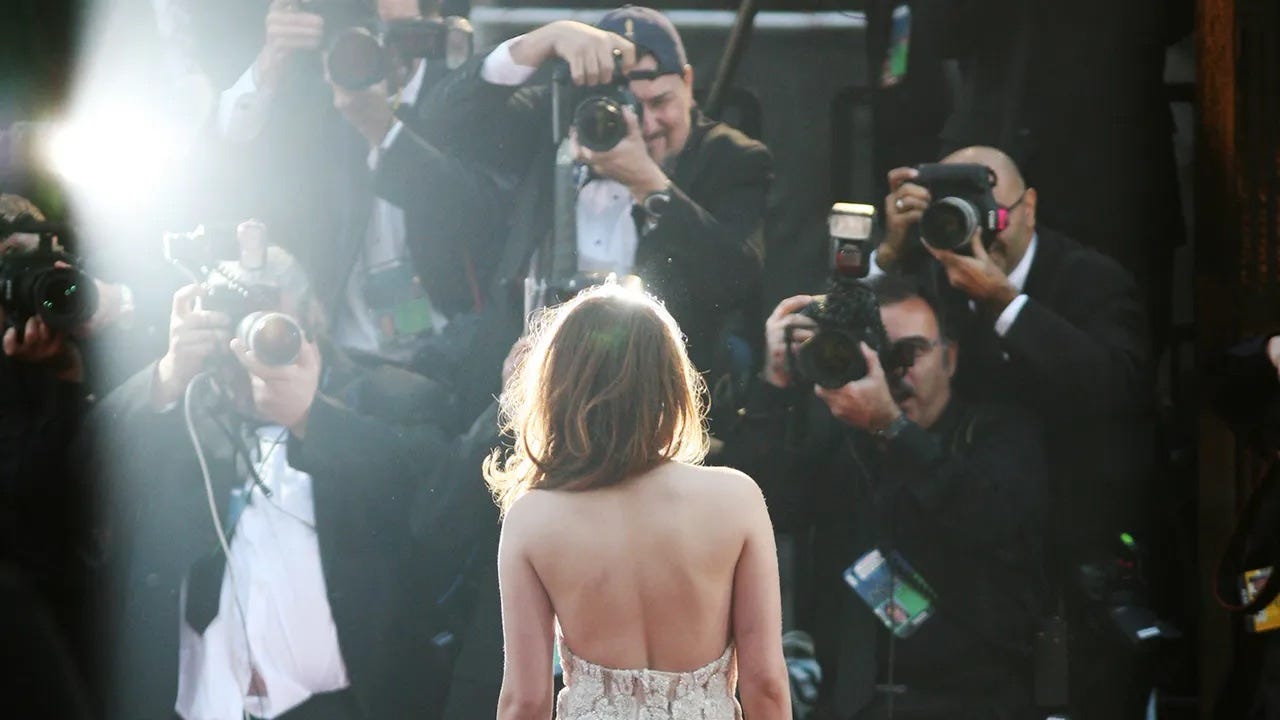
The Oscars red carpet does what it’s designed to do. It offers visibility without exposure. Every gown considered, every angle managed, every smile held for precisely long enough. The Oscars are the ultimate portrait-sitting. Almost none of it is true.
There were flickers of reality amongst the couture.
Accepting her award, Autumn Durald Arkapaw, the first woman and person of colour to win best cinematography, whose entire profession revolves around how and what we choose to look at, asked all the women in the room to stand, to be seen — because I feel like I don’t get here without you guys.
A K-Pop singer got emotional mid-speech, handed the mic to someone else, and was played off by the orchestra before they could finish. Genuine feeling, swallowed by the machinery.
Then Jessie Buckley walked to the microphone, and the room went somewhere else entirely. For a moment, nobody was managing anything.
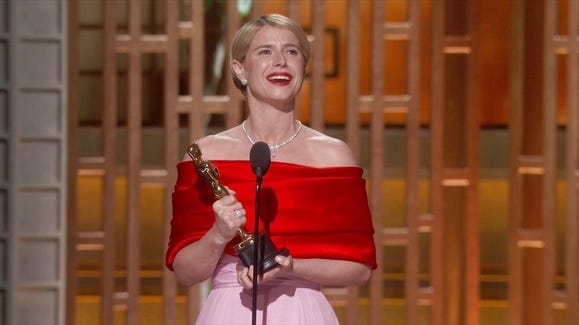
She has form for this. At the BAFTAs, she cracked something open with a few unscripted words about good girls and disobedience. At the Oscars, she did it again. On the biggest stage in cinema, in a room engineered for performance, she spoke about the beautiful chaos of a mother’s heart and a lineage of women who create against all odds. She was awarded for playing Agnes Shakespeare in Hamnet — a woman history had rendered invisible, a footnote to her husband’s genius. She won, and she stood there, insisting on being seen accurately. On Mother’s Day in the UK, the timing felt almost too deliberate, except it wasn’t deliberate at all. It was just true.
Later, accepting his best actor award, Michael B Jordan thanked director Ryan Coogler, saying: You gave me the opportunity and space for me to be seen. He wasn’t talking about screen time. He was talking about being truly looked at, recognised, held, in a role where he played two versions of the same man seen differently by the world around them.
These are the moments we’ll remember. Not the gowns and sharp tuxedos. Not the jewels. The moments when someone stopped performing and was just seen.
It made me think about a different kind of looking entirely.
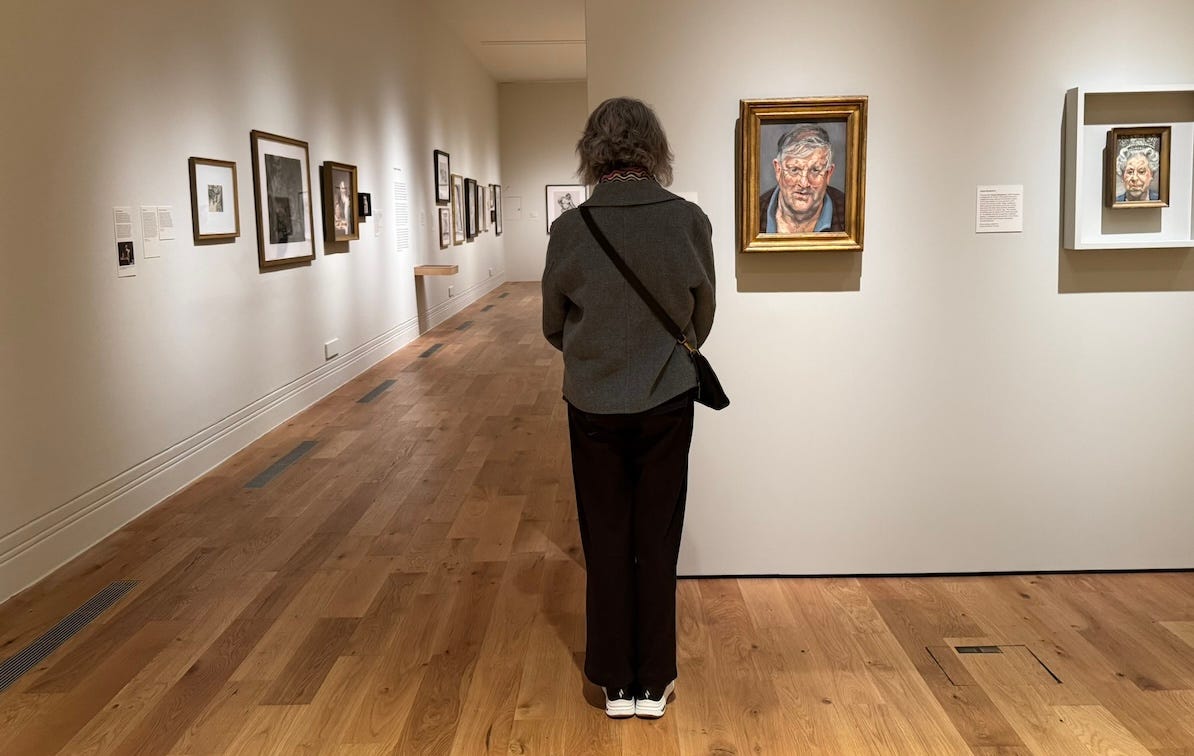
In quiet rooms of the National Portrait Gallery last week, the detail and quality of attention in Lucian Freud’s work was a masterclass in portraiture. The depth of understanding he brings to each study is wondrous. His pencil drawings, in particular, left me breathless, unable to look away. Freud is looking. And so, somehow, are his subjects. There is no flattery here, no managed angle.
The Duchess of Devonshire is said not to like her portrait. It was painted while she was in her thirties, and she thought she looked too old. Freud refused to flatter her into the version of herself she would have preferred to present. Was the portrait wrong? Who gets to decide what a true likeness is?
The day after the Portrait Gallery, I was at the Saatchi Gallery. It was a beautiful early Spring day in London. Around the steps of the gallery, the wannabe Chelsea set arranged themselves in the sunshine, not intending to enter the confines of the art space but performing for their snapping phones and Instagram feeds.
Inside, there was an exhibition of portraits and figurative work from six recent graduates of the Royal College of Art and the Slade School of Fine Art. Work by artists who are still figuring out who they are, yet choose to look outward. While my friend and I could critique their developing skill, I wondered whether these young artists, by choosing this particular genre, were putting more of themselves on the canvas than someone who might specialise in landscapes. More occupied with how others appear than with how they themselves might. Willing to study other faces and forms with sustained attention. What does it cost them to truly look?
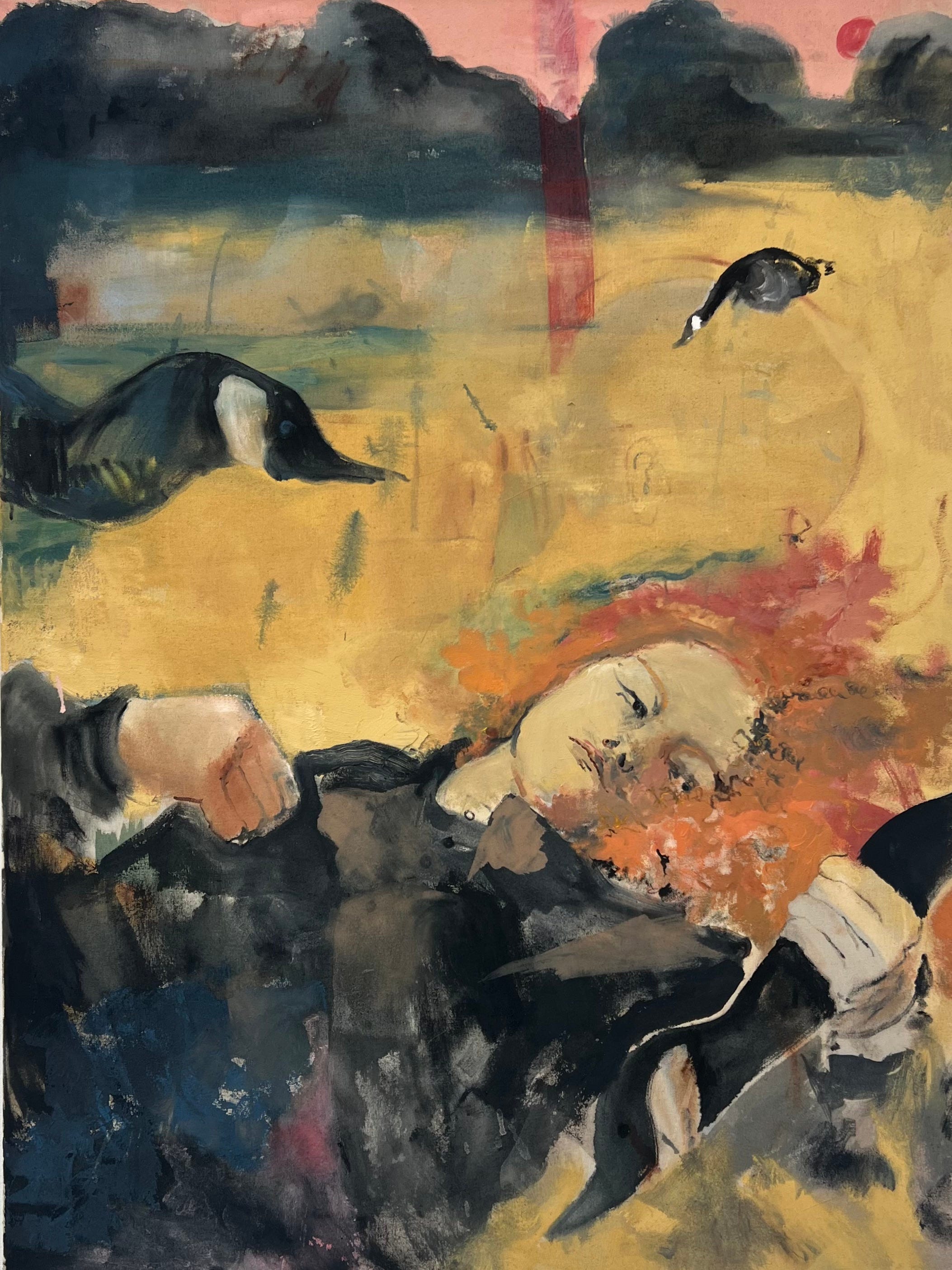
Most of us carry portraits of the people we love that we painted years ago and have never updated. Some people have done this with me. I let people keep outdated versions of me because changing the image asks something of them. It disrupts a comfortable fiction, and that can be hard. Uncomfortable. Asking them to rewrite their version of the truth. And it asks something of me too — the courage to let go of people who won’t update their version, to help others manage the transition, or just to let some people be, gently reminding them when it gets too much that I am not that person any more.
You might recognise the feeling. Whose portrait of you are you still living inside? And when did someone last really look — not at the version you’ve agreed to present, but at you?
After eleven nominations and no wins, Paul Thomas Anderson admitted, as he accepted one of his awards, that doubt never leaves, even at the moment of triumph. Freud knew this. The true likeness is rarely the comfortable one. But it’s the one that lasts.
The orchestra will always be ready to play you off.
Jessie Buckley handed nothing over. The question is whether you hand it over before you’ve said what’s true.
The idea of having portraits of people that we haven't updated really hits home for me...